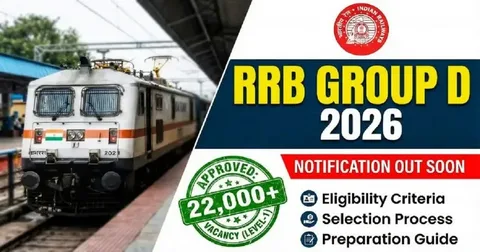
Railway Group D recruitment is one of the most popular government job opportunities for candidates looking to build a career with Indian Railways. The recruitment attracts applicants from across India because railway jobs offer opportunities in different departments and locations.
For candidates searching for Railway Group D 2026, it is important to understand the eligibility requirements, expected recruitment stages, syllabus, examination pattern, salary structure, and preparation strategy.
Railway recruitment details can change between recruitment cycles. Therefore, candidates should always check the latest official notification before applying rather than relying on old vacancy numbers or previous recruitment rules.
What Is Railway Group D Recruitment?
Railway Group D recruitment is conducted for various entry-level positions within Indian Railways.
Depending on the recruitment notification, positions can be associated with areas such as track maintenance, engineering support, workshops, electrical departments, mechanical departments, and other railway operations.
The exact post names and vacancies depend on the recruitment cycle.
Railway Group D positions can be suitable for candidates who want to enter the government sector without requiring a graduate-level qualification for every position.
However, applicants must satisfy all requirements listed in the official notification.
Railway Group D 2026 Eligibility
Educational qualification is one of the most important factors candidates should check.
Depending on the recruitment notification, candidates may need a Class 10 qualification or an approved technical qualification such as ITI.
The exact requirement can differ according to the post and recruitment rules.
Candidates should also check:
- Age limit
- Nationality
- Medical standards
- Physical requirements
- Category requirements
- Other conditions mentioned in the notification
Possessing the minimum educational qualification does not automatically guarantee eligibility.
Age Limit
Railway recruitment normally specifies a minimum and maximum age.
The applicable age is calculated using a particular date mentioned in the recruitment notification.
Certain eligible categories may receive age relaxation under applicable government rules.
Candidates should therefore check the official notification for the exact age calculation date and applicable relaxation.
Railway Group D Exam Pattern
The selection process can include several stages.
Depending on the recruitment cycle, candidates may have to complete:
- Computer-Based Test
- Physical Efficiency Test
- Document Verification
- Medical Examination
The exact selection process should be confirmed from the current official notification.
Computer-Based Test
The computer-based examination can cover areas such as:
- Mathematics
- General Intelligence and Reasoning
- General Science
- General Awareness and Current Affairs
Candidates should check the official examination notification for the exact number of questions, marks, duration, and negative-marking provisions.
Mathematics Syllabus
The mathematics section can include basic and intermediate arithmetic concepts.
Important topics may include:
- Number system
- BODMAS
- Decimals
- Fractions
- LCM and HCF
- Ratio and proportion
- Percentage
- Mensuration
- Time and work
- Time and distance
- Simple interest
- Compound interest
- Profit and loss
- Algebra
- Geometry
- Statistics
- Age calculations
- Pipes and cisterns
- Calendar and clock
Candidates should focus on improving calculation speed.
Regular practice can make it easier to solve numerical questions within the available examination time.
General Intelligence and Reasoning
The reasoning section evaluates logical thinking and problem-solving ability.
Topics may include:
- Analogies
- Alphabetical series
- Number series
- Coding and decoding
- Classification
- Relationships
- Syllogism
- Venn diagrams
- Directions
- Mathematical operations
- Data interpretation
- Conclusions
- Decision making
- Analytical reasoning
Candidates should solve different types of questions rather than repeatedly practising only familiar topics.
General Science
The science section can cover basic concepts from subjects such as:
- Physics
- Chemistry
- Biology
Candidates preparing at the school level should revise fundamental concepts and important everyday applications of science.
Previous-year papers can help identify commonly tested areas.
General Awareness and Current Affairs
General awareness is another important part of railway examination preparation.
Candidates can study:
- Indian history
- Geography
- Indian polity
- Economics
- Sports
- Important events
- Government programs
- Awards
- Science and technology
- Current affairs
- Important national and international developments
Current affairs should be studied regularly rather than left until the final weeks.
Railway Group D Physical Efficiency Test
Candidates who qualify for the written examination may be required to take a Physical Efficiency Test, depending on the applicable recruitment rules.
The physical test is designed to assess candidates’ endurance and physical ability.
The exact standards can vary according to the recruitment notification and candidate category.
Candidates should not rely on physical-test requirements from older recruitment cycles.
Always check the latest official notification.
Railway Group D Medical Examination
Medical fitness can be an important part of railway recruitment.
Selected candidates may have to undergo a medical examination according to the medical standards associated with their post.
Different railway positions can have different medical requirements.
Candidates should therefore review the applicable medical category before choosing a position.
Railway Group D Salary
The salary for Railway Group D employees depends on the applicable pay level and government rules.
Employees can receive basic pay along with applicable allowances and benefits.
The overall salary can vary depending on factors such as location, allowances, and applicable government regulations.
Candidates should avoid relying on unofficial salary figures because pay structures and allowances can change.
The official recruitment notification and applicable railway pay rules should be used for accurate information.
Railway Group D Job Responsibilities
The responsibilities depend on the particular post and department.
Some employees may work in track maintenance, workshops, electrical operations, mechanical support, engineering-related duties, or other railway functions.
Certain roles involve outdoor work, while others may be based in workshops or railway facilities.
Candidates should understand the nature of the position before applying.
How to Apply for Railway Group D Recruitment
When the official recruitment notification opens, candidates can generally apply online.
The process usually includes:
Step 1: Read the complete notification.
Step 2: Check educational and age eligibility.
Step 3: Visit the authorized railway recruitment portal.
Step 4: Register if required.
Step 5: Complete the application form.
Step 6: Upload the required photograph, signature, and certificates.
Step 7: Pay the applicable application fee.
Step 8: Review all details carefully.
Step 9: Submit the application.
Step 10: Download and save the final application and payment receipt.
Candidates should avoid submitting multiple applications unless the official notification specifically permits it.
Documents Required
Applicants should generally keep the following documents ready:
- Class 10 certificate
- ITI certificate, where applicable
- Identity proof
- Photograph
- Signature
- Category certificate
- Domicile certificate, if required
- Other certificates mentioned in the notification
The exact document requirements should be confirmed from the current recruitment notice.
Railway Group D Preparation Strategy
A good preparation plan should cover every subject included in the examination.
Start by studying the official syllabus.
Divide the syllabus into weekly targets.
Spend regular time on mathematics and reasoning because consistent practice can improve speed.
For science and general awareness, focus on understanding important concepts and revising them regularly.
Previous-year question papers are useful for understanding the examination style.
Mock tests can help candidates identify weak subjects and improve time management.
A Simple Daily Study Plan
Candidates can create a schedule based on their available study time.
For example:
2 hours: Mathematics
1.5 hours: Reasoning
1.5 hours: General Science
1 hour: General Awareness and Current Affairs
1 hour: Previous questions or mock test
The schedule can be adjusted according to individual strengths and weaknesses.
Candidates who are also required to pass a physical test should include regular physical training.
Common Mistakes to Avoid
Candidates should avoid these common mistakes:
- Applying without checking eligibility.
- Following outdated vacancy information.
- Ignoring the official syllabus.
- Neglecting physical preparation.
- Waiting until the final application date.
- Uploading incorrect documents.
- Entering incorrect personal information.
- Ignoring medical requirements.
- Trusting unofficial recruitment claims.
- Paying people who promise guaranteed selection.
Careful preparation and verification are essential.
Beware of Fake Railway Recruitment
Railway jobs are popular, and scammers may take advantage of candidates searching for vacancies.
Candidates should be suspicious of anyone promising guaranteed railway employment in exchange for money.
Recruitment is conducted through an official process, and selection cannot legitimately be guaranteed by an outside individual.
Always verify recruitment information through the official Railway Recruitment Board or authorized government source.
Conclusion
Railway Group D 2026 can be an important opportunity for candidates interested in entry-level government employment with Indian Railways.
Depending on the official recruitment notification, candidates may need Class 10, ITI, or another approved qualification. The selection process can involve a computer-based examination, physical efficiency test, document verification, and medical examination.
Candidates should prepare mathematics, reasoning, general science, general awareness, and current affairs according to the official syllabus.
Physical preparation may also be important for candidates required to complete a physical efficiency test.
Before applying, always verify the latest Railway Group D Vacancy, Eligibility, Application Dates, Exam Pattern, Syllabus, Admit Card, Answer Key, Result, Cutoff, and Selection Process through official sources.
With consistent preparation, regular practice, and careful attention to recruitment updates, candidates can approach the Railway Group D examination with a clear and organized strategy.